


I used to make coloring books for children’s hospitals. I would draw animals with various conditions and medical devices—a giraffe with forearm crutches, a unicorn with a trach tube—and kids in hospitals would color them. As a result, my wife and I would often see kids in the wild with different disabilities and offer their parents free coloring books. Most said yes. My wife is very extroverted and I’m an extreme introvert, so when it was just me, it would sometimes take me a bit longer to justify approaching a stranger.
One day, I spotted a woman and a boy with leg braces called AFOs, at the park where my sons and I were playing. He looked to be around six. My boys were nearby and just as I was preparing to approach the woman who would turn out to be the grandmother, something somewhat alarming stopped me in my tracks.
The boy with the leg braces was standing in the middle of one of those plank-type bridges that are so common in playground structures. They’re the kind that rock and sway and wobble about when kids are jumping up and down on them. Otherwise, they hang in a downward arch that looks as if the playground structure has a lazy smile. The boy with the leg braces wasn’t jumping, and though the bridge was smiling, an even smaller boy beneath the bridge was not.
“Ow. Ow! OW!” he shouted, trying to wriggle his little fingers free from the edge of one of the planks that he had decided looked like a perfect handhold from which to dangle. He would have been right, had the boy in the braces not taken the opportunity to grind his medicalized feet into the dangling boy’s fingers. The grandmother rushed over to pry the orthotic shoes off the other boy’s digits, and I was frozen in place.
This was no accident. The disabled boy was working his little shoe back and forth like a smoker snuffing out a discarded cigarette before returning to a shift at a barely tolerable job. He was holding the metal handrail and pushing down with all his might to get as much weight and leverage into the act as he could muster.
Now, listen. Sometimes kids are rotten. My boys are no exception, nor was I at their age. There are no perfect kids nor perfect parents. But this was different. What most unsettled me was the look of genuine pleasure on the disabled boy’s face. I’d only recently returned to college after leaving the service to study psychology, but I would have known the correct term for what I was seeing years before: sadism.
I would go on to approach the grandmother. She said yes to a coloring book. She also said, somewhat still aghast, that the little boy with leg braces did that sort of thing all the time. To kids. To his little sister. To animals. Even though I was early on in my education and eventual career in psychotherapy, I knew what that likely meant.
While I’ve yet to find a crystal ball that allows me to trace out the developmental trajectory of kids like that, that boy became a concrete example of why group identity politics could never work. I cared deeply about the plight of kids with disabilities and their families—my own son has CP—but an uncomfortable realization settled over me that day.
Every sizable demographic category has its fair share of murderers, psychopaths, sadists, and opportunists.
Which means you have to treat people as individuals and not police or legislate on the basis of demography—lest you unwittingly advantage the small but durable subpopulation of bad men and women that exist across every identity group without exception. You cannot extend blanket moral immunity to a category of people without handing that immunity to predators inside the group. One such predator—who understood exactly how to exploit a society foolish enough to overindulge in what I’ve come to call Infant-Predator Politics—was a twenty-three-year-old man named Vickrum Digwa.
BRIEFLY, THE FACTS
Henry Nowak was eighteen years old. A first-year finance student at the University of Southampton. Polish-British. By all accounts, a kid at the beginning of his life. According to the BBC, on the night of December 3rd, 2025, Nowak was walking home in Southampton after an evening out with friends when he crossed paths with Digwa. After appearing to notice a large dagger, which as of right now only Sikhs are legally allowed to carry in England, Nowak thumb-flipped off of his Snapchat conversation and began to film the strange encounter.
“Are you a bad man?” Nowak asked Digwa in what would be the last video he would ever film. Digwa answered in the affirmative. “I am a bad man,” he said and grabbed the eighteen-year-old’s phone. What happened next is only known by Digwa, but the Judge of the case believes it’s likely that Nowak tried to get his phone back and was stabbed by the so-called ceremonial blade. Nowak tried to escape over a fence to a nearby house.
At around 11:30 PM, Digwa’s brother called emergency services and claimed, despite allegedly not being on the scene until later, “We just got attacked, racially, by some white person.” Seven minutes later, when police arrived, Digwa recounted a story in which he and his brother were the victims of racism—a statement that the Judge would eventually call a “wicked lie.” Henry Nowak, meanwhile, was lying between a brick wall and a black bumper, bleeding out. Police dragged him by the belt band to where they could reach him. As they were sitting him up, having to hold him in order for him not to slump over, one officer asked, “What’s happened here, all right?”
Henry responds, “I’ve been stabbed.”
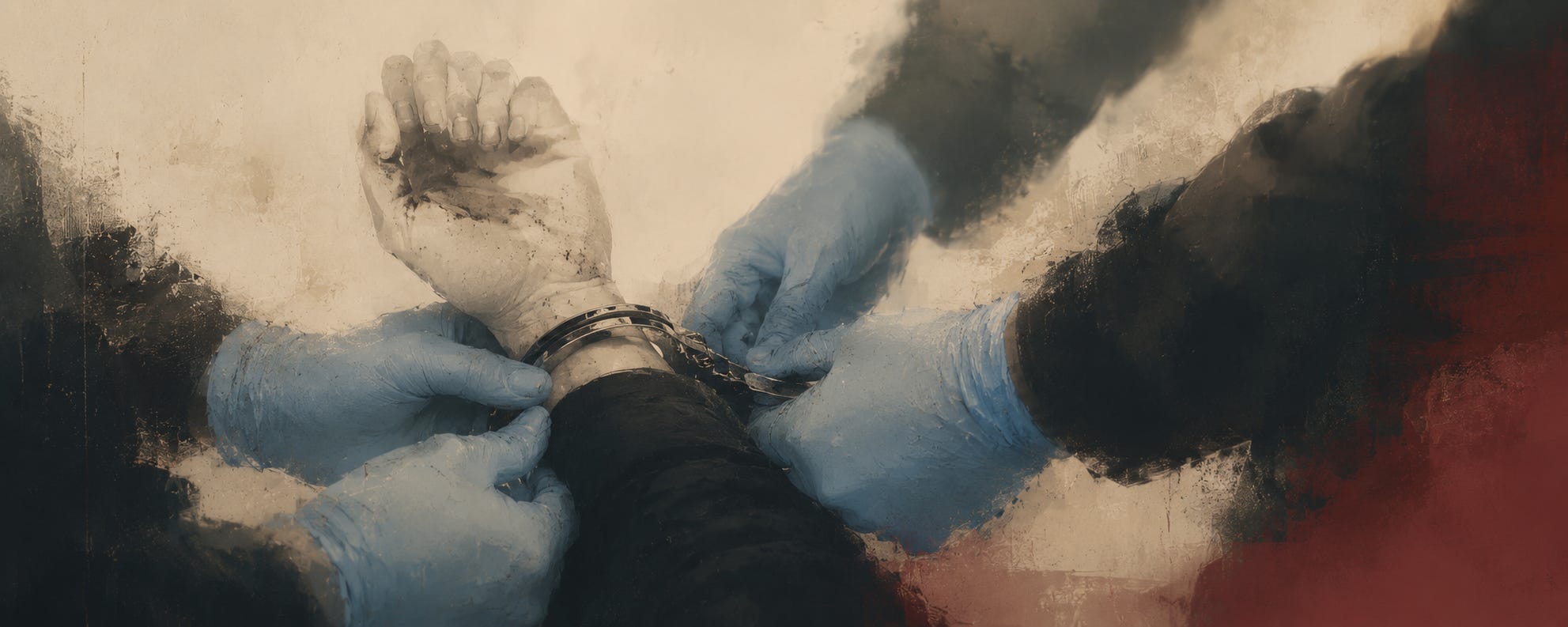
The same officer replies, “You’ve been stabbed? Whereabouts?” while he and a female officer roll the eighteen-year-old onto his side with his hands behind his back. “Don’t think you have, mate,” he says as he handcuffs Henry. Nine times, the young man told police that he couldn’t breathe. They placed him under arrest and read him his rights. He died shortly thereafter in handcuffs.
Many people are drawing parallels between the case of Henry Nowak and what happened to George Floyd in May of 2020. I’m not here to relitigate either case, they’ve both been decided in a court of law, and of course there are differences between the two circumstances. What I am noting, however, because the current situation demands it, is the asymmetry with which institutions, politicians, and media coverage have reacted to both instances.
One death triggered global protests, toppled statues, and produced a billion-dollar cultural reckoning that led to permanent reorganization and reculturation of how police forces are expected to interact with members of different groups across the Western world. Not to mention all of the photo-ops of outraged leaders in COVID masks kneeling in solidarity with Black Lives Matter, politicians calling for “unrest in the streets,” and pro basketball players wearing “I CAN’T BREATHE” shirts.
The other triggered an internal investigation and resulted in media framing the outrage with all the predictable epithets, a government minister on television warning against “misinformation and inflammatory commentary,” and activists (who supported the 2020 riots) urging everyone to “turn the temperature down.” This asymmetry is unmistakable. More importantly, to those reasonably versed in the various trait theories of personality as well as moral psychology, it’s both strikingly familiar and the almost inevitable product of two psychological phenomena colliding.
GAME THEORY AND PREDATORS
Ironically enough, in 2020, just five weeks after the George Floyd riots began, researchers published a study in the Journal of Personality and Social Psychology that still hasn’t received the cultural attention it deserves. Across a series of experiments involving more than 3,500 participants, Ok et al. demonstrated that people high in Dark Triad traits—the clinical constellation of Narcissism, Machiavellianism, and Psychopathy—are significantly more likely to engage in what the researchers called “virtuous victimhood signaling.”
The mechanism seems to be as straightforward as it is ugly. The combination of victim signaling with virtue signaling—I am both innocent and wronged—turns out to be a somewhat optimal strategy for extracting nonreciprocal resources from other people. People feel most inclined to help someone who is simultaneously suffering and morally blameless. Even when researchers controlled for every factor that could presumably make them a so-called target for mistreatment, the correlation between high victim signalling scores and Dark Triad traits held.
Said plainly, it seems to be the case that over and above the potential for genuine vulnerability, those who are likely to score high in psychopathy, opportunism, and a willingness to manipulate others find it an effective strategy to claim victimhood status.
Additionally, a separate body of research has established that Dark Triad traits—particularly psychopathy and machiavellianism—are among the strongest predictors of whether or not someone will defect in the age-old prisoner’s dilemma experiment (where two people can either keep faith with one another or screw the other for a better deal). In game theory, defection is when one player breaks a cooperative agreement for personal gain while the other player, operating in good faith, absorbs the cost. Machiavellians defect due to strategy and long-term scheming, while psychopaths defect on impulse. Both defect.
What Digwa did on that street in Southampton bears a striking resemblance to this dynamic. He committed an act of violence, then immediately flipped the frame—declaring himself the victim of a racist attack—and watched as officers on scene, operating within a cultural and institutional climate that increasingly treats accusations of racism as axiomatically credible claims, responded in a manner consistent with what the strategy would predict.
ASYMMETRIC RESPONSES
Here’s where things get a little complicated and go well beyond politics. One predator defecting on a social contract and signaling virtuous victimhood does not a causal mechanism make. The primary reason why the Henry Nowak and George Floyd deaths are yielding such different reactions is the same reason why this essay belongs in ManPsych Magazine rather than a more sociopolitical commentary.
Twenty years ago, neuroscientists from University College London—a mere hour and forty-five minutes northeast of the college at which Nowak was a first-year student—published a study in Nature (this is the last study I’ll quote, I promise) that has been sitting in the literature for some time and only recently begun to make its rounds in the popular culture. In the current state of the field of psychology, there’s a chance it wouldn’t have been published at all.
Most people have an intact fairness circuit. Cheaters bother them. The researchers of UCL had men and women play a monetary game with what they believed to be other participants, but who were in fact actors—some of whom played fairly and some of whom cheated openly. Afterward, participants were shown cues indicating that those actors—both those who played fairly and those who cheated—were receiving painful electric shocks.
Researchers measured both self-reported responses and actual brain activity. When participants observed that someone who had played fairly was to be electrocuted—no one was actually electrocuted, mind you, otherwise it never would have cleared an ethics review board—both men and women “showed” empathy. Which is to say, they self-reported concern for the person and showed increased neural activation in brain areas commonly associated with experiencing pain oneself and empathizing with others’ pain (namely, the anterior insula and the anterior cingulate cortex).
When confronted with the notion of cheaters being electrically shocked, however, the reaction of the sexes diverged somewhat. While both men and women experienced a reduction of both reported and observed empathy, men showed significantly less empathy. In fact, they showed neural activity consistent with satisfaction.
Put bluntly, not only were the men less likely to empathize with a defector, they were more likely to show signs of satisfaction when that defector received what they considered to be earned punishment.
The head researcher of the study concluded that the findings of the experiment suggested “a predominant role for men in maintaining justice and issuing punishment.” Conclusions from moral psychology, such as Carol Gilligan’s work, would likely map well onto this finding in that men tend to score higher on what is called an Ethic of Justice, while women score reliably higher on an Ethic of Care. I think it’s fair to say that, in recent years, Western societies have become tilted too far toward the latter. Outside of laboratory games, the people most willing to defect on social contracts are often the very same sorts of people—psychopaths, Machiavellians, opportunists, and strategic victim signalers—that societies must be designed to guard against.
As I recently alluded to in a previous essay, infant-predator politics have become fairly dominant in Western cultures. This leads to civilizational reflexes that sort everyone into either a vulnerable innocent requiring protection or a predator/oppressor requiring elimination or at least marked suspicion as to their motives, with no real meaningful categories between.
An Ethic of Care— which doesn’t require much of a logical leap to associate with a greater willingness to empathize with defectors—taken to institutional dominance becomes Infant-Predator Politics. This doesn’t just inform media, politics, and policing to instinctively side with virtuous victim signalers from perceived vulnerable group identities—it is the culture from which these policies and reactions are derived.
It’s what put handcuffs onto a dying eighteen-year-old boy who was accused of racism while Vickrum and Gurpreet Digwa watched.
Already, the same media apparatus that framed years of urban unrest as “mostly peaceful” and produced unending montages of global leaders on bended knee is up to its old trick—framing any legitimate outrage at two-tiered policing and asymmetric media coverage as some variant of negative personhood. Thankfully, most people have an intact fairness circuit. So, most people aren’t listening to the spin anymore.
Instead, they’re fully aware of the extent to which they’ve been manipulated into an asymmetry of response to tragedy depending on the demographic on the receiving end of the injustice. More importantly, they’re aware of just how susceptible a society dominated by an overdeveloped Ethic of Care is to being gamed by sadists, murderers, psychopaths, and opportunists who exist within every imaginable demographic group. Already, I’m seeing asymmetry in people demanding that upset citizens “turn the temperature down” and not sow division and hate by making this about race, which feels a bit odd.
I don’t think this has to be about indicting an entire race. Digwa is, of course, not representative of all Sikhs everywhere. I find it truly unsettling—perhaps due to my still intact fairness circuit—that the same people and institutions who have insisted at every turn since 2020 that everything be seen through the lens of race and the privilege of one group in particular, can’t see that they created the very conditions necessary for a young, British man to die handcuffed and formally under arrest over a “wicked lie” about racism.
If this framework is worth spreading, subscribe. It’s free.
The study about the difference between male and female empathy makes me think it's how the state can get men to do terrible things to innocent people. Demonize the enemy enough, and the men will think they deserve it.
But the opposite, "Never blame anyone for anything," ain't gettin us nowhere. I think there's some point of balance between Justice and Care.
Combine ambient social justice with the feminization of society where the masculine is coded as bad and it would seem that dreadful outcomes are an inevitability.