


Let me borrow your internal movie maker for a bit. I’ll give it back, I promise.
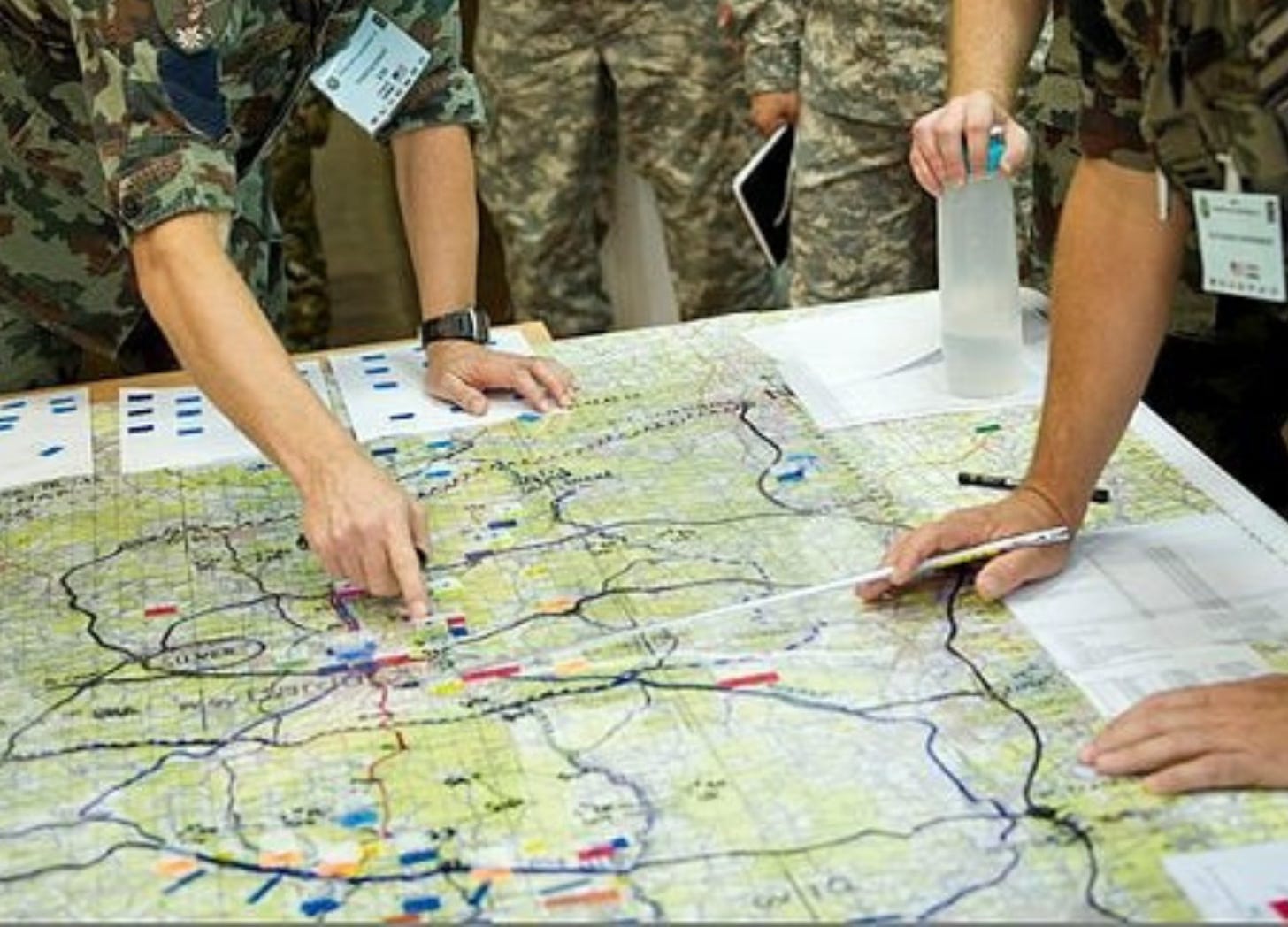
I want you to imagine a war room. Put it inside a tent. There’s a huge map sprawled out atop a big table surrounded by hard men. What type of warriors are they? Horse-riding Samurai? Anglo-Saxons in heavy, jingling mail? Modern Spec-Ops guys kitted out in plate-carriers and FAST helmets? It doesn’t really matter. What matters is that they’re all gathered around, analyzing the enemy’s position—and that at least one of them is smoking a pipe.
Picture one of the men closest to the table—preferably not the pipe smoker—pressing a dusty finger onto the map. He could be pointing at a gate, a tunnel, or any viable building entry. It doesn’t make much of a difference, so long as he’s indicating a spot that an enemy would have a hell of a time defending, monitoring, and/or restricting access to. Now, imagine him speaking up, probably in a higher-pitched voice than you might have otherwise expected.
“Here’s the weakest point in the enemy’s position—the place where they’re the most vulnerable.” A few heads nod. There are a couple of grunts of agreement as the others see it, too. So, he carries on. “Then, by all means—and at all costs—we should avoid it entirely because, you know, vulnerability is strength.” The room goes quiet.
I picture him standing up a bit taller, convinced that what he just said is both useful and perhaps a little profound. In my mind, he’s smacking fruit-flavored gum, while everyone else in the tent is trying to wrap their heads around the nonsense that came out of his mouth. Finally, someone breaks the silence. It’s the guy with the pipe.
“What in the hell did you just say?” he says.
If the reply from Captain Vulnerability is anything other than a laugh and an admission that he was just messing around, he’ll likely be stripped of command faster than a knife fight in a phone booth. Rightly so—because he’s an idiot.
Vulnerability isn’t a strength. We know this intuitively, yet people (psychotherapists, teachers, life coaches, etc.) will proclaim otherwise, and they will do so proudly. This wouldn’t be a big deal, except for the fact that the way a person and, more importantly, a society defines strength actually matters. It has real-world implications, many of which we are only just now beginning to see at scale.
VULNERABILITY:
When challenging an idea, it can be useful to start with the things that both sides agree upon. So, let’s start with a list of things that any reasonable person would classify as vulnerable. Since we’re talking about living things—humans—we’ll stick to examples of other living things.
Infants.
Babies are universally considered to be vulnerable.
For the first few months, they’re like human larvae, covered in grubworm folds and wriggling about clumsily and yelling about every displeasure or need. Their need for protection and provision is so absolute that responding to it seems to be baked into the biology of parents—most of them, anyhow. Infants have zero defenses beyond their ability to hijack our peripheral nervous system via their car-alarm-level wails. They rely completely on others for their survival. Babies are inarguably vulnerable.
Old people.
The older, the better. The very old among us are uniquely susceptible to all sorts of injury and maleficence from ne’er do wells and physics alike. Whereas young people can oftentimes take a long trip off a short set of stairs and land like Willy Wonka losing his cane in a cobblestone crack (or at least avoid catastrophic injury), a small fall for an old person can lead to serious injury—sometimes even death. Additionally, old folks are particularly soft targets for scammers and crooks alike. Any delinquent with the upper body strength of a teenage boy can overpower the vast majority of them. Elderly people are very vulnerable.
Endangered species! Endangered species are so vulnerable that the two words are interchangeable. By definition, their entire genus is nearing extinction. That’s pretty vulnerable.
Each of these is a rock-solid example of vulnerability. All three have a heightened susceptibility to injury, attack, and/or mortality if left alone to the natural order of things, which doesn’t sound like strength to me. Vulnerability and strength can be related—in the way that fear and bravery can be related—but the two words are nowhere near synonyms. So how did the idea that vulnerability is strength take hold of the collective?
A VERBAL SHELL GAME:
People manipulate language for all sorts of reasons. Good poets make art with words, bending and distorting dense and distilled forms for effect. Novelists construct worlds that feel both real and familiar using only their lexicon. Comedians become masters of misdirection and wordplay in order to snap together ideas at the perfect time and ignite amphitheaters of people into shared laughter. These verbal manipulations, in their purer forms, are done in the spirit of beauty, benevolence, and play. Which is a good thing.
However, when people begin to use language to distort public perception on a matter—attempting to reconfigure reality to their own aims—the human capacity for linguistic manipulation becomes malignant. Sometimes, it’s immediately evident and stomped out quickly. Other times, the effects may catch slow traction and take a little while to fully manifest. I’m not sure if the most well-known among those who succeeded in artificially elevating vulnerability to the status of virtue knew exactly what they were doing, but I am sure that they poured gasoline onto embers of victimhood that were already being stoked in the West, which have since become a raging, culture-consuming fire.
There were many ideological chefs in the soup kitchen, helping to elevate vulnerability to the level of virtue. Most of them were in psychology and adjacent fields. However, among them, no one person has put the idea more firmly and permanently on the cultural menu than Brené Brown.
Brown is a social worker, researcher, and sociology professor who has spent the past two decades working tirelessly to both destigmatize shame and normalize vulnerability. She’s written six number-one New York Times bestsellers. She’s been on Oprah a handful of times. At the time of writing this, her TEDx has over 65 million views. In short, she’s the heavy-hitter when it comes to how this bad idea reached escape velocity.
Brown has become so iconic in our overly psychologized culture that her books and TED talk have become a staple in graduate and undergraduate psychology programs alike. Her work was brought up in several of the courses that I was required to take for both my undergraduate and graduate degrees. There’s one quote in particular that you’ll see plastered all over PowerPoints and Pinterest posts, as well as on the websites of mid-level psychotherapy private practices aplenty.
“Vulnerability sounds like truth and feels like courage. Truth and courage aren’t always comfortable, but they’re never weakness”.
These couple of sentences come from Brown’s book (which was a required textbook for a master’s level course) titled Daring Greatly. There’s a trick to the claim. Did you see it?
It’s a little manipulative rhetorical device called equivocation, which is a bit of a linguistic shell game by which the speaker can cycle between words quickly enough to blur the distinction between them. Usually, as is the case with Brown’s example, it’s to bend or outright replace the definition of one term in particular.
In the quote-become-mantra, we draw two lexical comparisons almost immediately. Firstly, vulnerability sounds like neither truth nor courage, but we understand what she means. She means that speaking truthfully can sometimes make a person vulnerable to attack, judgment, or ostracism from a group. This is true and something I imagine nearly every human has experienced at one point or another.
Secondly, we’re told that a link exists between vulnerability and courage in that they can have a similar emotional experience. This is also true. In order to be courageous, you must first have fear to overcome. If you’re vulnerable and susceptible to injury or harm, it takes courage to run into a burning building, which, for any sane person, offers a healthy dose of survival-adaptive fear. It’s the whole reason that we as a society laud the efforts of firefighters.
The real mastery of the trick, however, comes at the tail end of the statement—this is the part of the play that con artists running a shell game call “Palming the Pea.” Brown primes us for false agreement with two more truths: both truth and courage can be uncomfortable, and neither is a weakness.
Then, she flicks her wrist and waits for you to pull up a cup that, to your astonishment, has nothing underneath it. Did you see the play? Did you catch how “vulnerability sounds like courage” and “courage isn’t weakness” can quietly become “vulnerability isn’t weakness”? Then, somewhere along the way, millions of people walk away with the impression that “vulnerability is strength.” As if “not weak” and “strong” were the same card under the cup.
Most people can’t see the sleight of hand. They don’t want to. Why not?
A WILLINGNESS TO BE DECEIVED:
You can make a slew of arguments as to why some of us would be more susceptible to lexical manipulation than others (e.g., low verbal IQ, confirmation bias, the relief of cognitive dissonance, etc.). I think the answer to why so many people are willing to buy into the notion that vulnerability is strength is much simpler.
People respond to incentives.
Strength—the capacity to withstand great force or pressure—is really difficult to attain. That’s true for physical strength, mental strength, emotional strength, moral strength, and any other strength you can imagine. Becoming strong takes work and discomfort, regardless of whether it’s the type that resists gravity or existential suffering.
It’s not easy to become load-bearing, to become the type of person who isn’t quick to buckle. It’s not supposed to be. If it were, I’d argue that it wouldn’t be something that we instinctively, collectively, and universally value. Nor, interestingly enough, would it be something with enough benefit and social capital to make it worthwhile to subvert.
If people are assigned status, respect, and reputation based upon whether or not they’ve cultivated a useful amount of strength and formidability—which they are, consciously or unconsciously—the egalitarian types run into a dilemma.
What do they do about people who don’t want to “do the work” but still want to be seen as strong and formidable by others? Shouldn’t those people likewise have access to esteem in the eyes of the collective? Isn’t it unfair that they should have to voluntarily subject themselves to the uncomfortable and drawn-out processes of contending with hardship, growth, and humility to be considered laudable by society?
The problem with this type of reasoning is that firefighters aren’t virtuous solely for being flammable. A functioning society holds firefighters in high regard due to the fact that, despite being flammable, they run into burning buildings to save strangers. That’s because some people understand the value of becoming the type of creature who can make molehills out of mountains rather than the reverse. These people are worthy of our respect and admiration. They’ve earned it.
If the vulnerability obsessed among us were to put forth the idea that vulnerability isn’t always a bad thing—when coupled with legitimate virtues—I’d be much more open to hearing the argument. If they were to say that discriminant vulnerability is an essential part of the emotional maturity required for rich relationships, I’m actually on board with that message. After all, an overly hard and cold man doesn’t make for a good father or husband, but neither does the opposite. A man who lacks the capacity for strength when the people who rely upon him need it most is not to be lauded for being vulnerable in times of crisis.
Am I being nitpicky? Perhaps. Does it really matter if some lady conflates words to sell books? Perhaps not. Does it impact society at large if she manages to get onto talk shows and offers people an overly convenient worldview, as well as access to unearned status? I suppose it depends on how many people believe it.
If enough people buy into the notion that being vulnerable is analogous to strength, it erodes the value of strength itself and undermines the accomplishments of the type of people that we depend upon—whether we want to admit it or not.
Sure, both sexes have their strengths, but by and large, it’s physically strong men who protect others. Emotionally strong men keep their feelings out of the driver’s seat when dangerous things need doing. Mentally strong men do the seemingly impossible things that allow a culture’s lights to stay on—so that the general public can continue to have access to safety, Wi-Fi, and Frappuccinos.
Strength is one of the primary load-bearing pillars of masculinity, through which young men in particular find a way to be useful to society. It’s one of the currencies of their contribution. No amount of doublespeak or oppositional defiance on daytime talk shows will change this—nor will it change how much the world desperately needs more of it.
Words have meaning. Vulnerability isn’t strength. Strength is strength. More importantly, how we define it matters.
If this framework is worth spreading, subscribe. It’s free.
Hard to disagree with anything here, even though I'm not a particularly agreeable person. At a tangent, but perhaps not unrelated, I feel as though I've lately been seeing a lot of talk about empathy. Specifically from men who claim that they aren't getting any from women. Are they justified in complaining about this? I don't think so. It seems to me that, in order to survive and thrive, women and their offspring do well by having men around them who can protect and provide resources for them. In the case of a husband, it is also welcome but not mandatory if he is competent around the house, looks after his own personal hygiene and grooming, has a sense of humour, can occasionally engage in intellectual conversation and is 'good' in bed. For all of those things he may reasonably expect gratitude and affection in return, which serve as a sort of interpersonal 'glue'. But empathy looks to me to operate as a social glue more at the communal or societal level. If someone in my community suffers a calamity not of their own making, then I may well empathise with them and act on that to offer help, if I can; but if I don't or hardly know them, notions of affection and gratitude are irrelevant. I suspect that women are simply not hard wired to be empathetic towards men. It might even be maladaptive if they were to be so. Being a male can be quite a dangerous and not uncommonly lethal vocation. So perhaps it's best for women, with their primary focus on protection and resources, to always keep their options open, consciously or unconsciously, and not get too empathetic about their current squeeze, saving their empathy for their own women-folk. And my counsel to men tempted to whine about a lack of empathy from women would be to forget it, concentrate on being the best version of a man you can be and reasonably expect a bit of affection and gratitude for that. The rest is noise.